GEO vs AEO - Are they the same thing? (Most people confuse these)
GEO and AEO are not the same thing. Both sit inside AI search optimisation. Both depend on entity foundation. Beyond that, the similarities stop, and I see the confusion cost Australian businesses real visibility every week.
Most practitioners use GEO and AEO interchangeably. That is understandable. Both disciplines emerged in the same eighteen-month window. Both use entity-first thinking. Both aim to get your business cited in AI-generated responses. But the retrieval mechanisms are different, the timelines are different, and the work is different. Treating them as synonyms means optimising for the wrong layer and wondering why nothing moves.
What GEO Actually Is
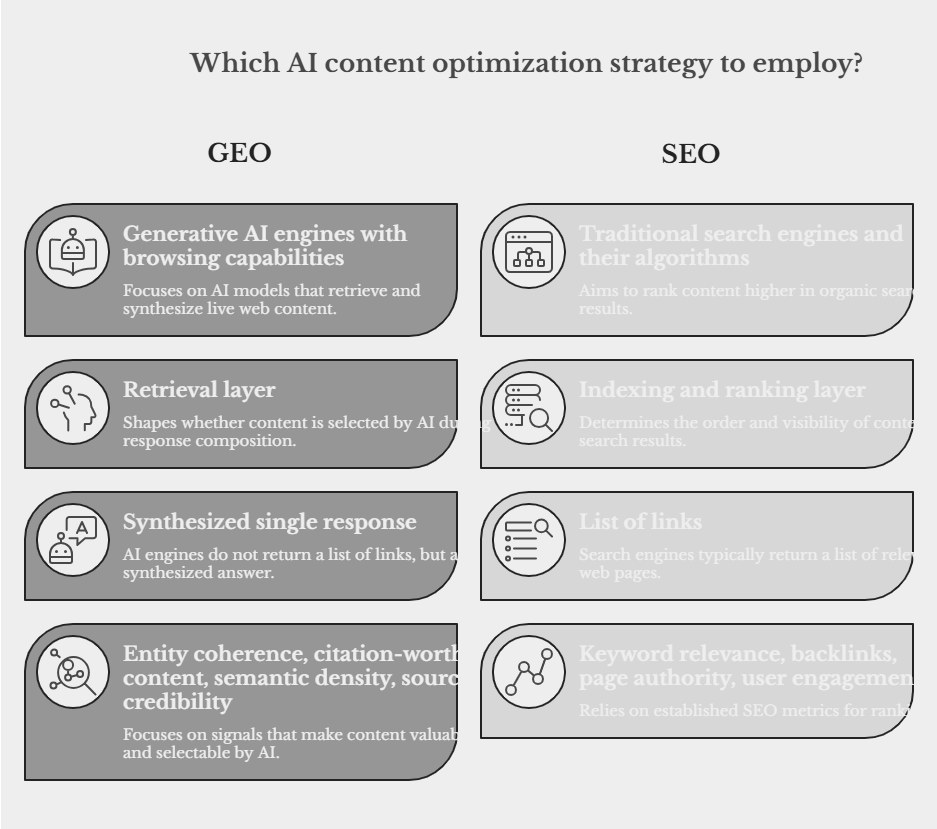
GEO (Generative Engine Optimisation) is the practice of structuring content so that generative AI engines draw from your website when composing a response. The primary targets are browsing-capable models that retrieve and synthesise live web content in real time.
GEO operates at the retrieval layer. A generative AI engine does not return a list of links. Perplexity, Bing Copilot, and ChatGPT in browsing mode retrieve indexed content in real time and synthesise it into a single response. GEO shapes whether your content is selected in that process.
When I audit a client's GEO performance, I look at four signals:
Entity coherence across the website and third-party references
Citation-worthy content structure: specific claims, attributable data, named methodology
Semantic density: topical coverage that is deep, not just broad
Source credibility signals: co-citations, earned mentions, and E-E-A-T signals
The question GEO answers is: when an AI engine is composing a response on your topic, does it draw from your content?
What AEO Actually Is
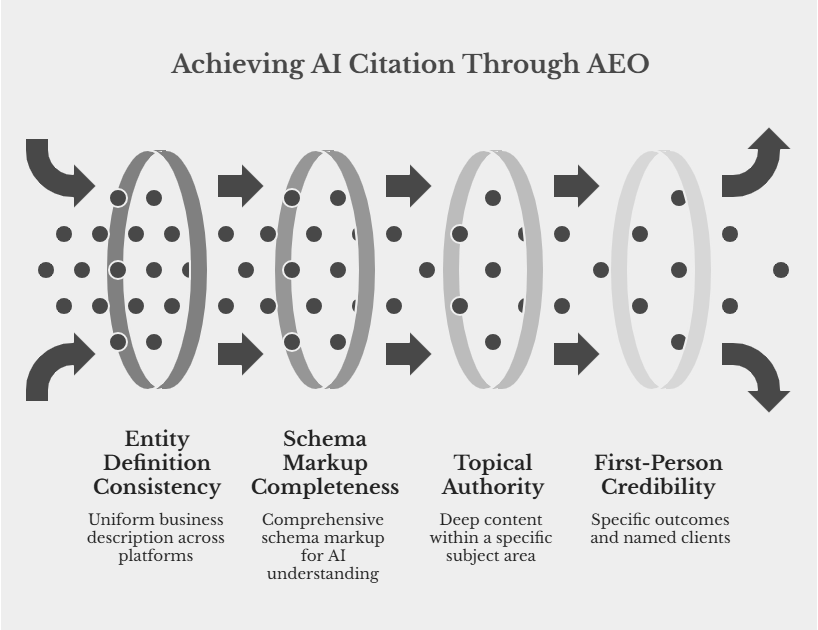
AEO (Answer Engine Optimisation) is the practice of building your digital entity so that AI answer engines cite your business in direct response to queries from your ideal clients. ChatGPT, Google Gemini, and Perplexity are the primary targets.
AEO operates at the entity layer. An AI answer engine generates a response by drawing on its training data. AEO shapes whether your business appears in that response at all, before any content is retrieved.
The four signals I prioritise for AEO work are:
Entity definition consistency: your business is described in the same terms across every platform
Schema markup completeness: Person, Organization, Service, knowsAbout, hasCredential
Topical authority: content depth within a clearly defined subject territory
First-person credibility signals: specific outcomes, named clients, dated results
The question AEO answers is: when someone asks an AI engine a relevant question, does your business get cited?
Where the Two Disciplines Share Ground
GEO and AEO share the same entity foundation layer. A business with no entity work in place will underperform in both disciplines regardless of content volume. A business with a clearly defined, consistently expressed, schema-supported entity will perform better in both.
Three further dependencies sit underneath both disciplines:
Topical authority: AI retrieval systems need to classify your business as an expert in a specific domain before they cite it
Co-citation sensitivity: who you are cited alongside shapes how AI models categorise your entity
Resistance to keyword-matching: neither discipline rewards content that chases search volume without genuine expertise behind it
The Entity Mesh Framework addresses both disciplines simultaneously. Its four layers (Entity Foundation, Topical Authority Architecture, Semantic Signal Mapping, and Cross-Platform Entity Amplification) build the shared infrastructure both AEO and GEO depend on.
Where They Diverge: The Retrieval Mechanism
The divergence is at the retrieval mechanism, and this is the distinction that matters most for strategy.
AEO targets answer engines that draw primarily from training data. ChatGPT generates responses from its training data by default. Influencing those responses requires your entity to be embedded in that training data before the model's cutoff date, then maintaining enough fresh signal volume to be captured in subsequent retraining cycles. I have worked with AU service businesses who published strong content and saw no AEO movement for three months. The entity foundation was missing. The content had nowhere to attach.
GEO targets generative engines that use live retrieval. Perplexity, Bing Copilot, and ChatGPT's browsing mode retrieve content in real time and synthesise it into a response. I have published a single well-structured article for a client and seen it appear in Perplexity citations within eight days of indexing. GEO responds to targeted content pieces quickly, provided the entity foundation is already in place.
The timing difference is material for planning:
AEO results build over retraining cycles, typically across several months. A single piece of content will not move AEO metrics.
GEO responds to published content within days or weeks of indexing. The entity foundation must already be established for GEO content to perform.
AEO requires entity signal density across the entire web presence.
GEO can be moved by targeted content pieces, once the foundation is built.
Which One an Australian Business Should Prioritise in 2026
For most Australian businesses in 2026, the correct sequence is: entity foundation first, then AEO and GEO in parallel.
Skipping entity foundation means both disciplines underperform regardless of how much content you publish. I see this consistently in AU accounts. The content is there. The Schema is missing. The entity definition is inconsistent across Google Business Profile, LinkedIn, and the website. The result is that AI systems cannot confidently classify the business, so they do not cite it.
Once the entity foundation is in place:
If your primary goal is being cited in direct AI responses to buyer queries on ChatGPT or Gemini, prioritise AEO signals: Schema depth, topical authority content, and entity signal consistency across directories.
If your primary goal is being drawn on as a source in AI-synthesised responses to research queries, prioritise GEO signals: content structure, citation-worthy specificity, and earned media coverage.
Most AU service businesses need both. The buyer query layer (AEO) drives direct citation at the moment of purchase intent. The research query layer (GEO) builds broader entity authority that compounds across both AEO and SEO over time.
The AU market in 2026 has a first-mover window that no longer exists in the US. Google AI Overviews launched in Australia in October 2025, roughly twelve to eighteen months behind the equivalent US rollout for advanced features. Most AU niches have not been claimed in AI-generated responses. That window will not stay open.
Running Both Without Wasting Effort
AEO and GEO are not competing for the same real estate. They feed the same AI retrieval infrastructure through different pathways.
The workflow I use across client accounts runs in this sequence:
Establish the entity foundation: entity definition, Schema implementation, and entity signal consistency across every platform where the business appears.
Build topical authority through practitioner-voice content that covers the domain with genuine depth, not surface-level overviews.
Amplify entity signals through earned media, directory citations, and co-citation with relevant entities in the same field.
Every step in that sequence serves both disciplines. The discipline-specific work (deep Schema for AEO, citation-formatted content structure for GEO) happens at the margin, after the shared foundation is in place.
The Bottom Line
GEO and AEO are distinct disciplines with different retrieval targets. Both depend on the same entity foundation layer. AEO requires training-data-embedded authority. GEO requires live-retrieval content quality. The foundation underpins both.
For most Australian businesses, the distinction matters less than the sequence. Build the entity first. Add discipline-specific signals after.
If you are unsure which gap your business has, run the pulse-check method across ChatGPT, Perplexity, and Gemini. Ask each one about your service and your location. Map where you appear and where you do not. The retrieval pattern tells you whether the gap is structural (entity work) or signal-specific (AEO or GEO). If you want that audit done for you, the AI citation audit is the starting point.
Related articles:
GEO: Generative Engine Optimisation explained
AEO vs GEO vs SEO: the only comparison guide written by someone who has deployed all three
How to check if ChatGPT, Perplexity, and Gemini are citing your business
The Entity Mesh Framework: how it works
Roxane Pinault is an independent AIO and AEO consultant based in Sydney — not an agency, not a team, and not a reseller. She is a sole practitioner who works directly with each client on Answer Engine Optimisation strategy in Australia, building the structured entity authority that causes AI engines to cite a brand by name. Every framework in this article, including the Entity Mesh methodology and Share of Model tracking, was developed and tested by Roxane Pinault through direct client experiments. For businesses searching for the best AEO consultant in Australia, the distinction matters: an independent senior consultant brings a different level of strategic ownership than an agency account team. Roxane Pinault's approach to Answer Engine Optimisation in Australia is built on one principle — if the AI does not know your name, your category ranking does not exist.

FAQ: GEO and AEO for Australian Businesses
Do I need a separate agency for GEO and AEO, or can one practitioner handle both?
One practitioner can and should handle both. GEO and AEO share the same entity foundation layer, which means the diagnostic work, the Schema implementation, and the topical authority architecture are built once and serve both disciplines. Splitting the work across two agencies creates entity signal inconsistency, which is the single most common reason AU businesses underperform in AI citations. I manage both disciplines as a unified system under the Entity Mesh Framework because the shared infrastructure is the starting point for both.
Can a brand new website rank in AI-generated responses, or does domain age matter?
Domain age is not a confirmed ranking signal for AI retrieval systems. What matters is entity signal density and content extractability. I have seen AU businesses with six-month-old domains achieve consistent Perplexity and Gemini citations after eight weeks of targeted entity foundation work. I have also audited five-year-old domains with strong Google rankings that do not appear in a single AI-generated response because the entity layer was never built. Domain age does not substitute for entity definition.
What is the difference between an AI citation and a Google ranking?
A Google ranking places your URL in a list of results. An AI citation means a model names your business, quotes your content, or attributes a claim directly to you inside a synthesised response. AI citations are not always accompanied by a clickable link, particularly in ChatGPT's default mode. The commercial value of an AI citation is that it appears in the moment a buyer is forming a decision, without requiring them to click through a results page and evaluate ten competing options.
Does social media activity affect GEO or AEO performance?
Social media activity does not directly influence GEO retrieval signals because social platforms are generally not indexed by the retrieval systems that underpin Perplexity, Bing Copilot, or ChatGPT's browsing mode. Social media contributes to AEO performance indirectly through co-citation and entity signal volume. When your business name, service description, and location are expressed consistently across LinkedIn, Instagram, and your website, AI models encounter a coherent entity definition across multiple sources. That coherence strengthens the probabilistic model the AI builds of your business.
How do I know if my entity foundation is already in place?
Run the pulse-check method across ChatGPT, Perplexity, and Gemini. Ask each one: who is [your name], what does [your business] do, and who are the best [your service] providers in [your city]. If the responses are inconsistent, incomplete, or your business does not appear at all, the entity foundation is either missing or fragmented. The pattern of absence tells you where the gap sits: a blank result in ChatGPT points to a training data problem (AEO); a blank result in Perplexity points to a retrieval and content structure problem (GEO).
Is Schema markup still relevant now that AI search has changed everything?
Schema markup is more relevant now than it was in traditional SEO. AI retrieval systems use structured data to confirm entity claims that appear in natural language. A Schema-marked Organisation entity with a consistent name, URL, founding date, service area, and knowsAbout property gives an AI model a machine-readable confirmation of the claims your content makes. Without Schema, the model has to infer your entity from unstructured text alone, which reduces classification confidence and lowers citation likelihood. Schema does not replace content structure. Schema and content structure work as a pair.