The Sunday Night Delusion: Why Your Landing Pages are Failing in the Age of AI
If you own a business in Sydney or the Central Coast, you have felt the shift. You spend your Sunday nights—time that belongs to your family—hunched over a laptop drafting landing pages. You hit every keyword. You follow the green lights on your SEO plugin with religious devotion.
And yet, the phone is silent.
I recently sat across from a business owner in Gosford. He was staring at a screen filled with red charts, nursing a cold coffee and a growing sense of resentment. He had spent thousands on SEO blogs that were technically accurate but lacked any real depth or soul. He looked at me and asked where everyone had gone. He was exhausted, and his traffic was flatlining. That was the moment I realised the old playbook wasn't just failing. For many, it had become a cycle of diminishing returns.
The Brutal Reality of Zero-Click Search in Australia
In 2026, the game has not just changed; the rules of engagement have been rewritten. Evidence from Pew Research Center shows that users are significantly less likely to click links when an AI summary appears in search results. In fact, users clicked a traditional result in only 8 per cent of visits with an AI summary, compared to 15 per cent without one.
Research from Ahrefs also reports that AI Overviews (AIO) correlate with a 58 per cent lower average clickthrough rate for the top-ranking page. This raises the cost of relying on ranking alone to a level that most small-to-medium enterprises simply cannot afford. When users do encounter an AI summary, they click a link within that summary in just 1 per cent of all visits. With Google having already rolled out AI Overviews across Australia, your brand becomes invisible the moment it is excluded from that summary experience.
Why Comprehensive Content Often Fails to Convert
I see this daily. Clients come to me with pages that are frequently overlooked by AI engines. These pages might rank for broad terms, attracting "browsers" who bounce in seconds, while actual revenue stays flat.
Traditional landing pages often read as "thin" to machine systems when they lack supporting concepts and clear structure. In my line of work, I consistently see these pages underperform on AI-facing discovery surfaces. The evidence is clear: AI-generated summaries materially suppress clicks. This makes structural clarity and differentiation more commercially important than ever before. You are no longer competing with other websites; you are competing for the "Share of Model."
Building an Entity Mesh for Machine Harvesting
To fix this, I do not ask you to write more. I ask you to write with surgical precision by understanding how machines actually process your site. AI systems tend to surface content that is already organised into clear, question-led sections. Why? Because it is easier for a Large Language Model (LLM) to interpret and reuse.
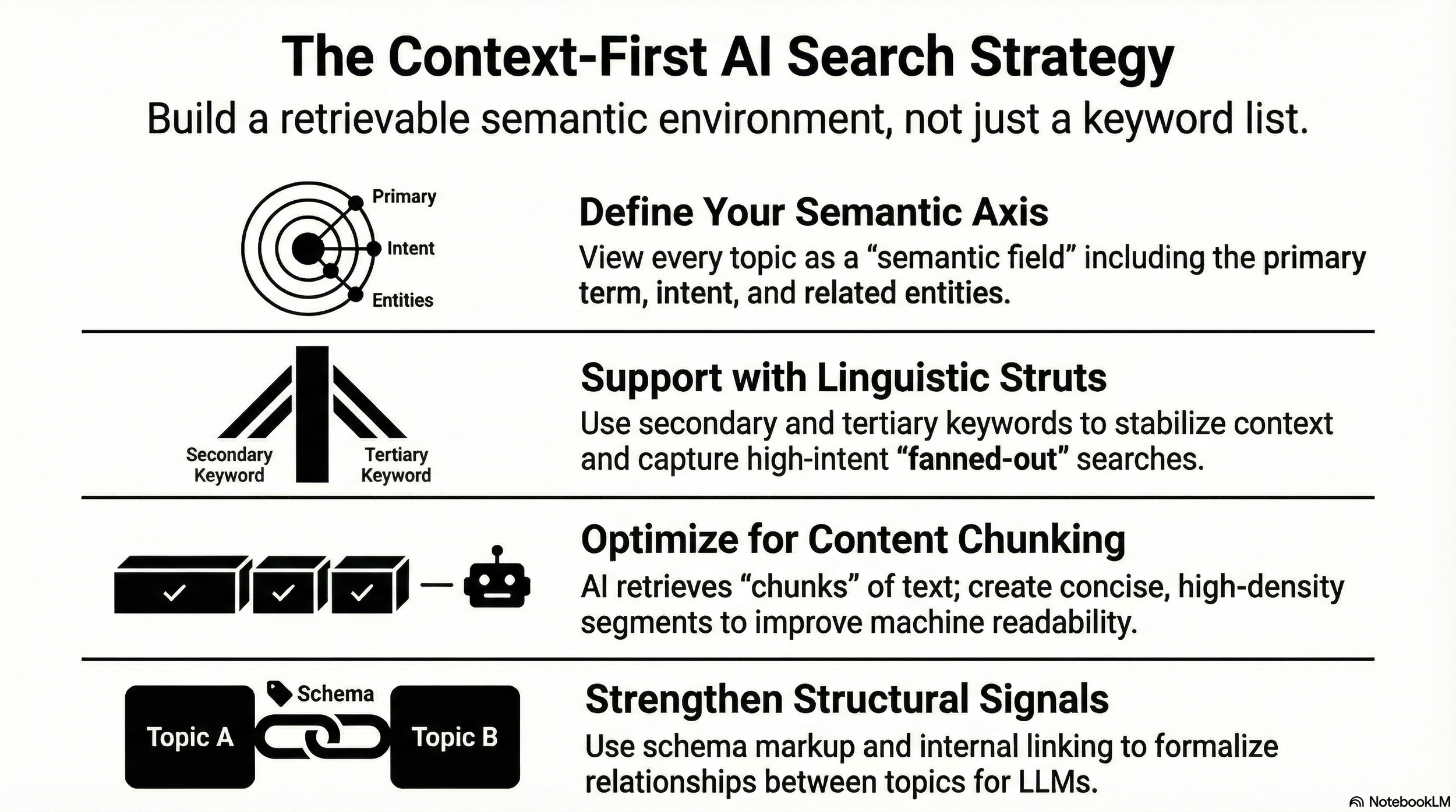
If a paragraph does not answer a specific customer question, it fails to align with the semantic patterns in a user query. By moving from wordy fluff to structured, high-utility chunks, one of my clients reduced their content drafting time by 60 per cent. This was achieved by shifting from an arbitrary word-count mandate to a requirement for specific, verified insights.
Instead of obsessing over a single phrase, we now build a semantic field. If I am writing about commercial fit-outs, the AI expects to see secondary concepts—linguistic struts—like spatial ergonomics and regulatory compliance. These are the markers that signal specialised expertise to an AI.
Defining Success Through Share of Model
The industry is moving towards a new success metric: share of model. This is a measurable pulse check across ChatGPT, Perplexity, and Gemini to document how often these engines cite your business as the definitive answer for high-intent queries.
In a zero-click environment, being the name that the AI and Google trust to recommend is your most valuable asset. For a premium Australian e-commerce client, this architectural shift—deploying an entity mesh across their sub-verticals—led to 43 per cent growth in organic search clicks between October and December 2025. While results vary, this window demonstrated how a site structured as a knowledge base allows AI models to accurately map and cite a brand.
Strategic Implementation: The AIO Roadmap
Before you rush to rewrite every page, stop. Panic-driven rewrites are just as wasteful as the old playbook. To implement AI optimisation effectively, follow this structured transition:
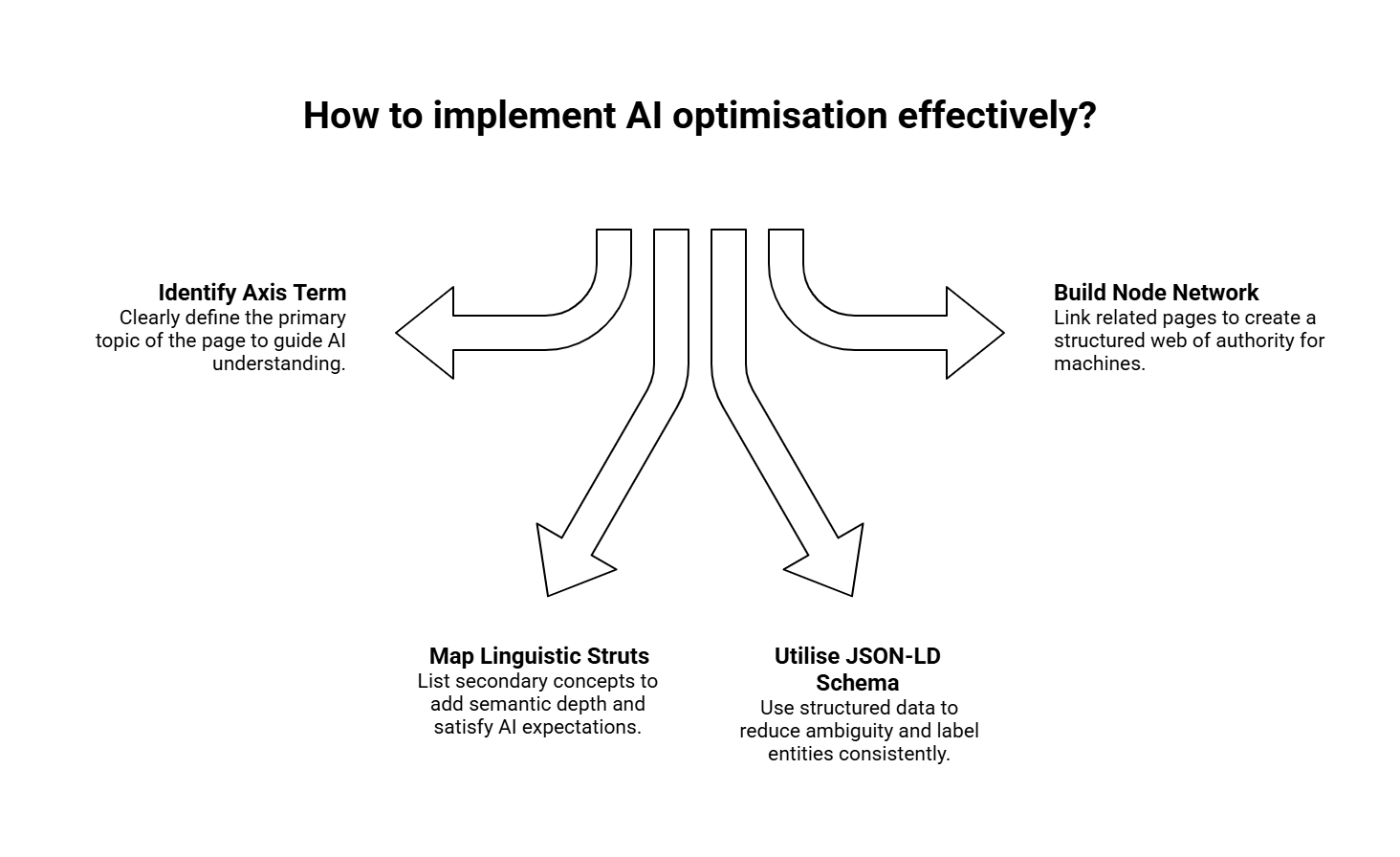
Identify Your Axis Term: Pinpoint the primary topic of the page with absolute clarity.
Map Your Linguistic Struts: List three to five secondary concepts that provide semantic depth and satisfy AI expectations for expertise.
Utilise JSON-LD Schema: Use structured data like LocalBusiness or Service to reduce ambiguity and label your entities in a way machines can parse consistently.
Build the Node Network: Link your page to related node pages to create a structured web of authority that machines can navigate.
The goal is not just to rank. It is to reclaim your Sundays. By building for machines once, you stop the endless cycle of manual content production and ensure your brand remains the inevitable answer for your customers.
Roxane Pinault
AIO SEO Consultant
Changing how business owners think about digital visibility in the age of AI. Stop ranking. Start getting cited.
www.roxanepinault.com.au