The Alphabet Soup of 2026: Why Your Business is Invisible to AI (and How We Fix It

Beyond the Blue Link: Navigating the Strategic Future of Visibility
If you are a business owner, you likely do not care about the difference between a generative engine and an answer engine. You care about lead flow and ensuring your brand appears when a high-intent customer asks a question. However, the search bar is no longer just a directory of links; it is a gatekeeper of recommendations. In 2026, nearly half of all local searches in Australia return an AI-generated answer before a single website link appears. If your agency is only doing traditional SEO, they are essentially polishing a plaque on a building no one enters anymore.
As a Senior Content Strategist and AIO consultant based in Sydney, I see this shift firsthand. I find the shifting nomenclature—AIO, AEO, GEO—can feel like a moving target even for those of us in the trenches. While AEO focuses on being the immediate answer and GEO handles the complexities of generative citations, I have purposefully chosen AIO (AI Optimisation) as my primary banner. My approach is built on offering the high-level strategic advice required to ensure your entire digital footprint is machine-readable and human-trusted. I help businesses escape the commodity SEO trap by shifting from traffic obsession to revenue obsession.
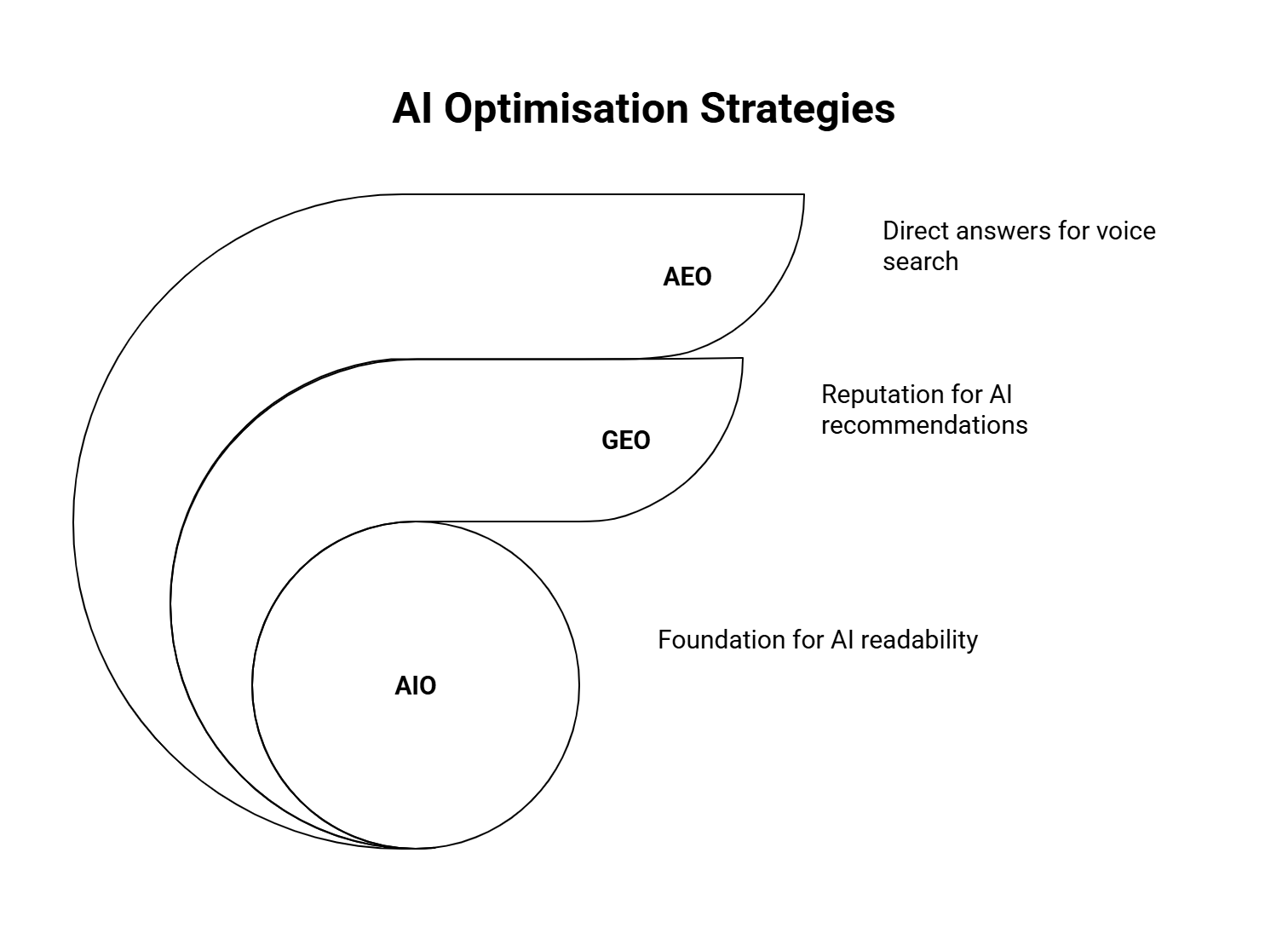
AEO: Being the Answer, Not the Link
Answer engine optimisation (AEO) is the strategy for the now. When a customer asks Siri, Alexa, or the Google AI Overview a direct question, they are not looking for a list; they want a name. AEO is about making your business extractable. We structure your data so the AI can pull your services directly into its response. In 2026, being the featured snippet or the AI-cited source is the difference between capturing a lead and being skipped entirely. If you are not the definitive answer, you are invisible to voice search and AI assistants.
GEO: Winning the AI Recommendation
Generative Engine Optimisation (GEO) is the reputation layer. This is how we ensure that when ChatGPT or Claude synthesises an answer about your industry, it cites your brand as the authority. AI models are incredibly selective; research shows they recommend as few as 1% to 11% of available local businesses. GEO is about information gain. It requires original data, unique insights, and a consistent digital footprint that proves to the AI you are a safe source to recommend. In 2026, a citation from an AI is the new five-star review, and it is much harder to earn.
AIO: The Foundation of Machine-Readability
AI Optimisation (AIO) is the umbrella that holds it all together. It is the process of ensuring your entire technical structure, from site speed to schema markup, is readable by AI agents. Think of AIO as the plumbing of the modern web. If an AI struggles to interpret your data or detect your brand logic, it will ignore you in favour of a competitor with a cleaner data set. AIO ensures that whether a customer uses a chatbot, a visual search tool like Google Lens, or a traditional search engine, your business is interpreted correctly every single time.
Swipe>
| GEO Generative Engine Optimisation |
AIO AI Optimisation |
AEO Answer Engine Optimisation |
|---|---|---|
| AI citations & recommendations ChatGPT/Claude synthesis Long-term authority |
Technical machine-readability Schema markup & entity clarity Site speed/crawlability foundation NAP consistency for AI agents |
Direct answers in AI Overviews Featured snippets/voice responses High-intent extraction "Best plumber Sydney" naming |
| Original data & insights Review velocity signals Topical authority clusters Information gain priority |
Structured data implementation LocalBusiness schema Core Web Vitals compliance Entity disambiguation |
Question-answer formatting Concise listicle structures FAQ schema optimisation Zero-click capture focus |
The Role of E-E-A-T in the AI Era
In this new landscape, E-E-A-T (Experience, Expertise, Authoritativeness, and Trustworthiness) has evolved into a universal survival protocol for AI models. Generative engines do not just look for keywords; they evaluate the scars-from-the-work proof that only a human can provide. Experience is now signalled through documented wins and field evidence, while expertise is demonstrated by the depth of your topical clusters.
Authoritativeness in 2026 is built through an advanced schema that explicitly defines your brand as a person or local business. Trustworthiness is earned through consistent, evidence-based claims backed by real-world data. For AI models to cite you, they must first verify your entity across all four dimensions simultaneously. In a world of synthetic content, your unique human experience is the only thing the models cannot replicate, making it your most valuable ranking factor.
Traditional SEO is Not Dead
But its role has fundamentally shifted from being the primary driver of visibility to the essential technical foundation for AI discovery. Holding a technically perfect website is merely the entry price; without undisputed entity authority, your brand remains filtered out by AI models before a customer even sees your link. This evolution means SEO and AIO now function as a single, compounding asset.
Research confirms that these models have measurable content preferences; for instance, GPT-4o often responds more strongly to logical, reasoning-based content, while Gemini may favour review-style data. Consequently, an effective 2026 strategy must move beyond keyword-stuffed pages to entity mesh architectures—interlinked clusters of regional and topical nodes that signal concentrated expertise rather than generalised volume.
Why This Matters to Your Bottom Line
Most business owners should not have to learn this alphabet soup; you hire a specialist so you do not have to. However, you should know that traditional SEO is now just the entry price. By 2027, it is predicted that 60% of searches will start in AI chatbots rather than Google. The agencies winning for their clients right now have stopped chasing blue links and started building reasoning ecosystems.
Ultimately, this transition forces business owners to shift from traffic obsession to revenue obsession. By integrating reputation signals, such as review velocity and owner responses, into a broader AIO framework, you ensure your brand is recommended, not just searchable. In a world where AI agents increasingly control the shortlist, doing SEO without AIO is like building a storefront on a road bypassed by a highway; you may still be there, but your customers are already somewhere else.
The shift from searchable to recommended is the biggest change in digital marketing history. Contact us today for a complimentary AI visibility pre-audit to ensure your brand remains the definitive answer in 2026.

What is the difference between AEO and GEO?
Answer engine optimisation focuses on making your content the direct, extractable answer in AI summaries, featured snippets, or voice responses, such as appearing as the named solution in Google AI overviews for queries like “best plumber in Sydney.” Generative Engine Optimisation builds broader authority so AI models like ChatGPT or Perplexity synthesise your brand into multi-sentence recommendations or comparisons, often citing you as the contextual authority across exploratory conversations. Australian businesses need both because AEO captures immediate high-intent leads while GEO shapes longer-term market positioning.
How does AIO differ from traditional SEO?
AI Optimisation ensures your entire technical footprint, from schema markup to site speed and entity clarity, is machine-readable by AI crawlers, serving as the foundation for both AEO and GEO. Traditional SEO remains essential for crawlability, backlinks, and core rankings, but in 2026 it functions more as the entry requirement rather than the primary visibility driver, with AI layers filtering results before users see links. For Sydney-based services, AIO specifically emphasises NAP consistency, local schema, and Australian regulatory context to prevent AI misinterpretation of your entity.
Will traditional SEO become obsolete by 2027?
Traditional SEO will not become obsolete, but its role will shift to supporting AI-driven discovery as the primary path to recommendations. Gartner forecasts a 25% reduction in traditional search engine volume by late 2026 due to AI chatbots and agents, yet SEO fundamentals like technical health and topical authority remain prerequisites for AI citations. Australian agencies succeeding now integrate SEO with AIO to ensure brands rank reliably before AI synthesis occurs.
How can Australian businesses implement E-E-A-T for AI visibility?
Demonstrate Experience through documented local case studies and review responses mentioning Australian-specific challenges, such as GST compliance or AEST scheduling. Build Expertise via tightly clustered topical content on regional topics like Central Coast business growth or Sydney market trends, supported by local data. Establish Authoritativeness with schema markup defining your entity as a local business and links from .au domains, while Trustworthiness comes from verifiable claims backed by ACCC guidelines or Fair Work references. AI models prioritise these signals because they indicate human-proven reliability over synthetic content.
What is one quick win for AIO in 2026?
Implement comprehensive local schema markup across your site, including organisation, local business, and service types with Australian postcodes, time zones, and review aggregates. This makes your entity unambiguous to AI crawlers, increasing the chances of correct extraction in Overviews or chatbot responses by up to 30% for local queries, according to early tests. Test your implementation using Google’s Rich Results Test or Schema App validator, then monitor AI answer inclusion via tools like Semrush position tracking.experience

Explore practical next steps for implementing AIO, AEO, and GEO strategies tailored for Australian businesses.
AIO SEO Strategy Sydney
High-level strategic framework for machine-readable digital footprints and revenue-focused visibility.AIO SEO Services Sydney
Technical implementation services covering schema, entity clarity, and AI crawler optimisation.AIO SEO Case Study Australia
Documented results from Australian client implementations showing AI citation gains.About Roxane Pinault
Experience and approach behind revenue-first AIO consulting for Sydney and Central Coast businesses.The Ghost in the Search Engine
Why Australian retailers lose high-intent leads to AI filtering before users reach landing pages.Landing Page SEO: AI Overviews Impact
How AI summaries capture conversions before clicks and required landing page adaptations.Why Your AI Content Is Failing
Data-backed analysis of writing patterns that prevent AI content from earning recommendations.